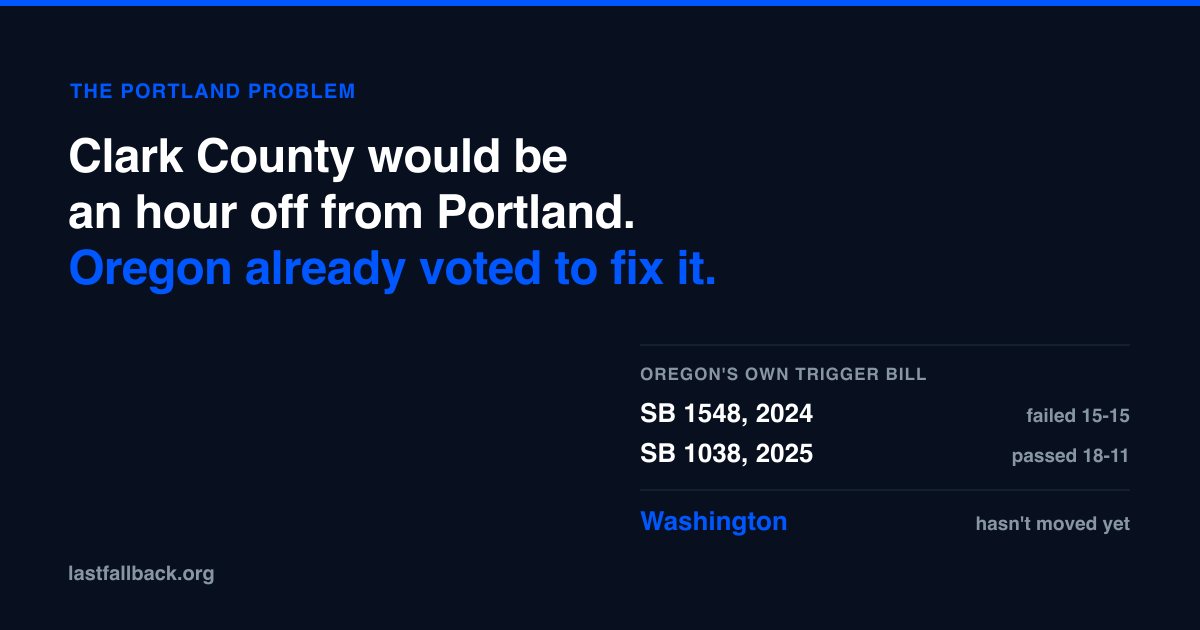
Whenever we talk with people near the Columbia River about the Last Fall Back Act, one question comes up every time. If Washington adopts permanent standard time and Oregon doesn't, Clark County would run an hour off from Portland for about eight months of the year.
That's not a small thing. Around half a million Washingtonians live in the Portland metro area, in cities like Vancouver, Camas, Washougal, and Battle Ground. Right now the whole West Coast shares one clock year-round. If Washington stops changing its clocks and Oregon doesn't, the two states fall out of sync for most of the year. That's a real cost, not a reason to wave off.
What most people here don't know is that Oregon has already tried to fix this on its own.
Oregon tried this before
In February 2024, Oregon state Sen. Kim Thatcher introduced Senate Bill 1548, aiming to put Oregon on permanent standard time. It looked a lot like the bills that have repeatedly stalled here in Washington.
On the Senate floor, the bill tied 15 to 15 and failed. As OPB reported at the time, lawmakers in both parties didn't want Oregon to act alone. They worried about confusion for people who cross state lines regularly, the same objection we hear about Washington acting alone.
Thatcher then switched her own vote to no, a procedural move that let her bring the bill back for reconsideration. Supporters added a trigger: Oregon would end its clock change only once Washington and California did the same. With that amendment, the bill passed the Senate 16 to 14. It then stalled in the House, which had only five weeks left in session.
They tried again, and went further
In March 2025, Thatcher introduced Senate Bill 1038, worth understanding in some detail. It proposes:
- Oregon follows if California and Washington both adopt permanent standard time within ten years.
- Oregon follows if Congress authorizes permanent daylight time and California and Washington adopt it.
- If neither happens, Oregon keeps its current rules.
On the floor, Thatcher said she couldn't predict the outcome, but that the bill gave Oregon its best shot at ending the clock change. It passed the Oregon Senate 18 to 11.
State Sen. Janeen Sollman of Hillsboro, who voted for it, put it plainly: the bill doesn't lock Oregon into anything yet. It says Oregon will move in step with its neighbors.
The Portland problem, reconsidered
Oregon has voted twice in consecutive sessions for a bill that depends on what Washington and California do. That changes the shape of the objection. The desynchronization is a real reason for Washington to think carefully. It's also one of the conditions Oregon has already set for itself.
To be precise, Oregon's trigger needs both California and Washington to move. Washington acting alone doesn't flip it. California has been quiet since 2018, when voters passed Proposition 7 but the Legislature never followed up. We also don't know what happened to SB 1038 after it passed the Oregon Senate and moved to the House.
But the direction is clear. Oregon's Legislature has voted twice to stop changing clocks in step with its neighbors. What's missing is somebody going first.
Oregon's exposure isn't evenly split
One detail in Oregon's trigger is worth noting. Oregon's border with California runs through small towns like Brookings and Klamath Falls, with modest cross-border traffic. Its border with Washington runs through a metro area of about two and a half million people who cross the river daily.
On paper, Oregon's bill treats California and Washington the same. In practice, the misalignment Oregon would actually feel is the one with us.
That cuts both ways. It's a reason for Oregon to care what Washington does, which helps our case. It also means the interim gap would land hardest on Clark County, where residents have no vote in Salem. We think that argues for writing coordination with Oregon into the plan, not for leaving the clock change in place.
Why we think the interim gap is worth it
Setting Oregon aside, here's the case on its own terms.
The cost of a temporary gap is limited and reversible. It lasts only until Congress acts, or until Oregon and California follow, and then it ends completely.
The cost of the clock change is neither. It repeats every March and every November, year after year. There's no point at which continuing it stops costing something.
We already live with a version of this misalignment without complaint. Twice a year, recurring cross-border meetings, flight connections, and market openings shift by an hour on a fixed date. It's worth asking why a stable one-hour offset would feel less tolerable than one that shifts twice a year.
One more data point: on November 1, Washington fell out of step with British Columbia and Alberta, and Washingtonians didn't get a vote on that either.
What you can do, if this is your bridge
If you're in Clark County, you have the most at stake and the least say in the half of this decision that gets made in Salem. Contact your legislators in Olympia and ask them to take this up in 2027. Find yours at lastfallback.org/take-action, or look them up directly at lastfallback.org/wa-legs.
If you have ties across the river, Oregon has a sponsor who has carried this bill twice. State Sen. Kim Thatcher of Keizer has been the most persistent voice on this in Salem, with cosponsors from both parties. Oregon residents can look up their legislators at lastfallback.org/or-legs and ask where SB 1038 stands.
If you know an organization on either side of the river that would care about this, a chamber of commerce, a cross-border employer, a transit or ferry operator, tell us. The strongest version of this ends with Washington and Oregon acting together, and that takes people in both states asking for it.
You can help in two minutes: sign up, and send this to one person who's tired of the clock change.
We'd prefer the Legislature act on the Last Fall Back Act in 2027. If it doesn't, we'll file a citizens' initiative and put the question back in front of the Legislature and the voters in 2028.