You got an hour back this morning. Enjoy it. You give it back on March 14.
That is the whole problem in two sentences. The hour is a loan, and twice a year the state collects on it, and every collection costs something measurable. This morning's change is the gentler of the two. It still comes with a bill.
What happened today, and what didn't
At 2:00 a.m. Washington set its clocks back to 1:00 a.m. The sun now sets before 5 p.m. in Seattle, and the evening commute moves into darkness in a single day.
Western Canada didn't. British Columbia stopped changing its clocks in March. Alberta stopped in May, and the Northwest Territories went with it. Manitoba announced in September that it was done too, and northwestern Ontario, which has always kept Manitoba's time, followed.* Yukon stopped in 2020, and Saskatchewan never started. None of them fell back this morning. As of today Vancouver is an hour ahead of Seattle, and it will be every winter from now on. If you cross the border, work with people up there, or have family on the other side, you are living with that starting now.
B.C. settled this in one legislative session. Alberta took about three weeks. Washington's Legislature voted to end the clock change in 2019, 90 to 6 in the House and 46 to 2 in the Senate, and has been waiting on Congress ever since. On July 14 the U.S. House passed the Sunshine Protection Act 308 to 117, and the Senate left for recess without acting on it. Its own version, S. 29, has sat in committee since January 2025. Nobody in Olympia or Washington, D.C. can tell you when that door opens.
What the hour costs
The week after falling back, deer-vehicle collisions rise about 16 percent, because evening commutes drop abruptly into darkness during breeding season. In March the bill is steeper: fatal crashes rise about 6 percent in the week after spring forward, worst in the morning and on the western edge of each time zone, which is where we sit. Workplace injuries rise 5.7 percent that Monday, and heart attack risk rises in the days after.
These are transition effects. They spike after a clock change and settle. They end entirely when the switching ends, whichever time the state lands on. That part is not seriously contested.
The harder question is where to land, and that one cuts both ways. Permanent standard time means lighter school mornings and shorter summer evenings. Permanent daylight time means the reverse. We think permanent daylight time is the right destination, which is what Washington's Legislature voted for in 2019, and the Last Fall Back Act gets there automatically once Congress allows. But a state can only choose standard time on its own, so that is the interim step, and it has real costs for as long as Congress takes. One of them is close to home: until Congress acts, Seattle would sit an hour behind Vancouver all year, not just in winter. We would rather say that plainly than have you find it out later. The FAQ goes through it in full.
Which clock change could be the last one
Here is the honest calendar.
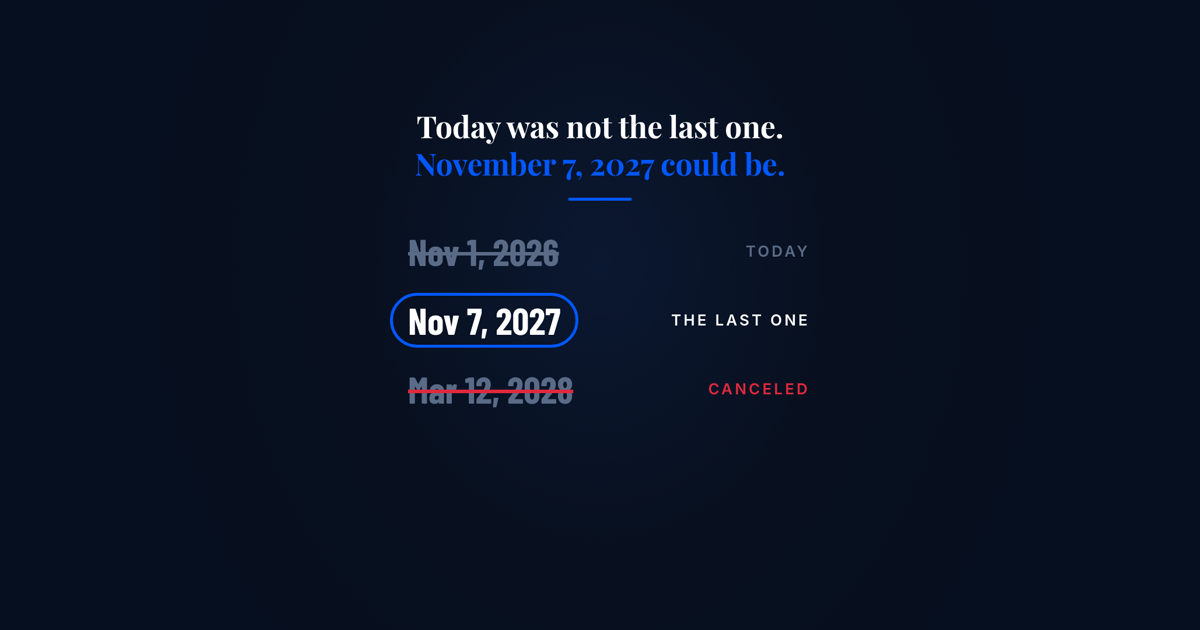
If the Legislature passes the Last Fall Back Act in the 2027 session, which runs January through April, the Act takes effect that summer, 90 days after the session ends. The spring forward on March 14, 2027 still happens; nothing can pass in time to stop it. Then Washington falls back one more time, on November 7, 2027, and the spring forward scheduled for March 12, 2028 is canceled. That November change is the last one. The Act spells this out in Section 3.1.
If the Legislature does not act, we file an Initiative to the Legislature in March 2027 and gather about 386,000 signatures through December. The measure goes back to the Legislature in 2028, and to the voters that November if they decline again. On that path the last clock change is November 5, 2028. That path only exists if enough people volunteer to carry it, which is the part we need from you.
So today was not the last one. Depending on what happens in Olympia over the next five months, it was the second-to-last time Washington falls back, or the third-to-last. That is a better answer than "someday," which is what Washington has had since 2019.
What decides it, and when
Washington legislators have introduced a state-level version of this bill four times: 2022, 2024, 2025, and 2026. None reached a floor vote. The 2024 version had thirteen bipartisan sponsors and the Association of Washington Business testifying in favor. It was scheduled for a committee vote and pulled before cutoff. It never lost a vote. It never got one.
The thing that changes that is legislators hearing from people in their districts, this month and next. Members decide what to prefile in early December. A bill that is not prefiled starts the session behind, and the committee calendar fills fast.
If you live in Washington, it takes two minutes. Find your legislators at lastfallback.org/take-action and ask them to introduce and pass the Last Fall Back Act in 2027: permanent standard time now, permanent daylight time once Congress allows. If you mention that you would rather this come from the Legislature than from a ballot measure, that is true, and it is worth saying.
If you live outside Washington, your lever is in the U.S. Senate. The House passed the Sunshine Protection Act in July. The Senate's version, S. 29, has not had a committee vote. That one bill is what would let Washington, and every other state that wants it, stay on daylight time all year. Look up your two senators at senate.gov and ask them to bring it to a vote.
We need volunteers to make this happen
Here is the plain arithmetic. If the Legislature doesn't act, about 386,000 Washingtonians have to sign a petition between March and December 2027. Signatures don't arrive by mail. Each one is a conversation with someone at a farmers market, a library, a front porch. A thousand volunteers collecting about 400 signatures each gets us there. A hundred volunteers does not.
So the number of people who raise their hand this month matters more than any argument in this post. It is how we decide whether to file in March. If the volunteers aren't there, we won't start a signature drive we can't finish, and Washington goes back to waiting on Congress.
You don't need experience, and you don't need much time. Volunteers help in whatever amount they have:
- Talk to your own legislators before December, and bring a neighbor.
- Collect signatures from friends, family, and coworkers once the petition opens.
- Staff a table at a local event in your town.
- Help organize in your county or legislative district.
If you've ever complained about the clock change, this is the moment it turns into something. Sign up as a volunteer and we'll be in touch about training, events, and signature collection.
Sign up to volunteer →Takes about a minute. The volunteer box is checked for you.
If you do one thing today: sign up to volunteer, then send this to one person who complained about the dark this evening and ask them to do the same.
We would rather the Legislature do this in 2027. If they don't, we file in March and the voters decide in 2028.
* It covers communities west of the 90th meridian, including Kenora, Dryden, Sioux Lookout and Pickle Lake. Ontario announced it on October 13. The rest of Ontario still changes its clocks. Ontario passed a law in 2020 to end the change province-wide, but it only takes effect if Quebec and New York move too.
Sources: SHB 1196, 2019 c 297; H.R. 139, House roll call 238, July 14, 2026; B.C. Ministry of Attorney General, March 2026; Government of Alberta; Global News, Manitoba, September 17, 2026; Cunningham et al., deer-vehicle collisions; Fritz et al., Current Biology; Barnes and Wagner, J. Applied Psychology; 2024 meta-analysis, 12 studies.